16.Le sorelle Macaluso
by Laura Di Bianco
DOI: https://doi.org/10.15781/c8d5-0q43

gender/sexuality/italy is an online annual, peer-reviewed journal that publishes research on gendered identities and the ways they intersect with and produce Italian politics, culture, and society.
by Laura Di Bianco
DOI: https://doi.org/10.15781/c8d5-0q43
by Veronica Vegna
DOI: https://doi.org/10.15781/nk7g-qy26
by Felice Cimatti
DOI: https://doi.org/10.15781/a3nw-1j44
by Damiano Garofalo
DOI: https://doi.org/10.15781/qpq9-dn59
by Russell Kilbourn
DOI: https://doi.org/10.15781/578g-cp19
by Lorenzo Marmo
DOI: https://doi.org/10.15781/bfpz-sk05
gender/sexuality/italy, 8 (2021)
Nicoletta Marini-Maio, Journal Editor
Paola Bonifazio, Invited Perspectives Editor
Ellen Nerenberg, Open Contributions and Continuing Discussions Editor
Erica Moretti and Colleen Ryan, Reviews Editors
Victor Xavier Zarour Zarzar and Lisa Dolasinski, Managing Editors
Arianna Avalle, Beatrice Basile, Leonardo Cabrini, Magda Collazo, Jacob DeCarli, Samantha Gillen, Katherine Travers, Assistant Editors
Table of Contents
Journal Editorial
NICOLETTA MARINI-MAIO, Dickinson College,
Journal Editorial by Nicoletta Marini-Maio, Paola Bonifazio, Ellen Nerenberg
The editorial includes the Editors’ introductions to their respective areas: Nicoletta Marini-Maio announces the topic and guest editors of the Themed Section: “Intersectionality in Italian histories, cultural products, and social practices.” Marini-Maio also highlights the section Collaborations, which hosts discussions and descriptions of current scholarly collaborations. Paola Bonifazio presents the rationale of the Invited Perspectives.
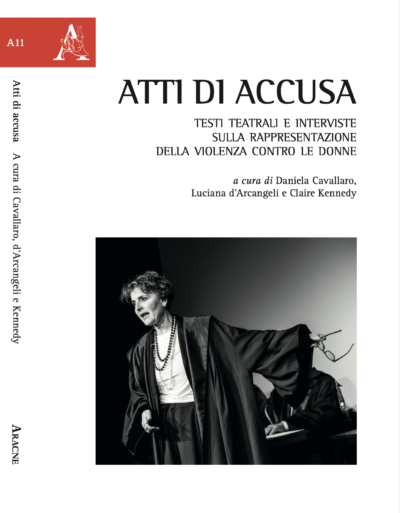
by Daniela Cavallaro, Luciana d’Arcangeli, and Claire Kennedy
This article describes our collaboration in creating a book containing plays on violence against women and interviews with the theater practitioners who wrote and staged them. The plays included in the book premiered between 2014 and 2018 in London, Sydney, and Rome. The three editors of the book are Italianists who work in Adelaide, Auckland, and Brisbane. Colleagues who have translated some of the plays are based in Melbourne and Sydney.
by Claudia Santoni
The essay traces the emergence of the framework of intersectionality in the evolution of feminist theory in a contemporary key. The intersectionality perspective allows us to identify the oppression of women in its various configurations, showing female subjectivities that differ in terms of ethnicity, culture, religion, race. All forms of inequality, therefore, have an intersectional character being the product of the interaction of different factors which then affect the opportunities and choices of individuals.