category: Invited Perspectives

7. Girls and the Media: Girlhood Studies Agenda and Prospects in Italy

by Romana Andò

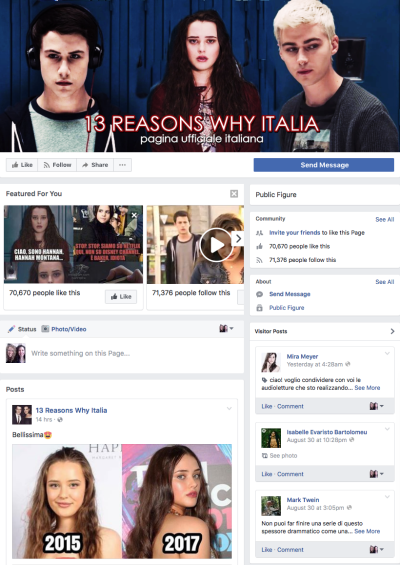
Within the Italian context, girlhood studies can hardly be considered a specific field: adolescence and gender construction in Italy have historically been investigated by sociology and psychology, although, in recent years, media studies have also focused on youth media consumption as a cultural process in the broader sense, investigating the relevance of the media in the identity-building process. Actually, the lack of a definition of girlhood studies as such did not prevent Italian research from providing theoretical contributions and significant research on girlhood,


Read more Download pdf

8. Le adolescenti che per caso ho raccontato nel mio Cinema

by Anne-Riita Ciccone

The filmmaker explains her interest in adolescence and discusses the topic and genesis of the
short Victims. She provides details on her feature I’M and on its young leading actress.

Click to watch the trailer.

The short Victims is available online on the Rai.it website. In Italian. Web. Accessed 27 July 2017.

DOI: https://doi.org/10.15781/rghr-7f50

Read more Download pdf

9. In un cerchio perfetto

by Laura Samani

In this essay, Laura Samani addresses the rich symbolism of the theme of adolescence as it appears in her short film La santa che dorme. She describes adolescence as an internal war waged between the desire to grow up and the fear of leaving behind the securities of childhood. Samani analyzes her own adolescent experiences under the watchful eyes of the Church and adults, and the double natured friendship/rivalries as they resonate in the short film.

Read more Download pdf

It’s Not Only a Matter of Pronouns.  Journal Editorial

by Nicoletta Marini-Maio

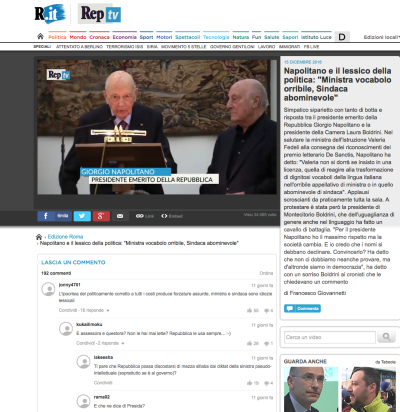
The editorial describes the genesis and structure of g/s/i 3, 2016. The author contextualizes the theme of gender and language making reference to the Anglophone world and the romance languages. She briefly discusses the contemporary debate on gender and language in Italy, drawing examples from gender markers in job titles in the Italian public discourse. She emphasizes how the current issue of g/s/i goes beyond the heteronormative framework.

DOI: https://doi.org/10.15781/erjz-5167

Read more Download pdf
no post image

Ricostruire il genere attraverso il linguaggio: per un uso della lingua (italiana) non sessista e non omotransfobico

by Michela Baldo, Fabio Corbisiero, and Pietro Maturi – Guest Editors

The guest editors’ introduction to the themed section focuses, on the one hand, on the resources that languages can draw on in order to adapt the use of grammatical gender to account for more equal relationships between men and women, and on the other hand on the fact that the use of the so-called “neuter masculine” in political and everyday discourses and in languages such as Italian,

Read more Download pdf
no post image

6. Sexism, misogyny and heteronormativity in Italian legal and media language. The case of “Stupro della fortezza da Basso.”

by Michela Baldo

Michela Baldo introduces the theme of the AAIS 2016 roundtable, that is those discourses of gender and sexuality circulating in Italy oriented in a homophobic, transphobic, sexist and misogynist way, but also the ways in which language can become a tool to fight discrimination. The author subsequently introduces queer linguistics, a branch of linguistics that aims to challenge essentialist, hegemonic and naturalized notions of gender and sexuality, and that can be useful in unmasking the work of heteronormativity in the formation of public discourses.

Read more Download pdf
no post image

7. Translingual Queer Practice

by Serena Bassi

Serena Bassi suggests that we rethink what the relationship between social change and evolution of language usage might look like. To offer a different perspective on the subject, she asks how a Translation Studies paradigm helps us reflect on the “gay rights” vocabularies that have appeared in various guises in Italy since the 1960s. In English.

DOI: https://doi.org/10.15781/vhpj-pr19

Read more Download pdf

8. On the Different Fates of “darla” and “darlo” in Italian

by Cinzia Russi

Cinzia Russi demonstrates how Darla “be promiscuous, of women” and darlo “engage in sodomy” first appear in the sixteenth century; in the late twentieth century, darlo acquires the meaning of  “have sex, of men” (same as darla but without the connotation of “easiness”). While darla is well established in the average speaker’s lexicon, darlo (in both meanings) remains highly marginal.

Read more Download pdf

9. AAIS 2016 Roundtable on Gender and Language: Language Inclusivity and the Subversion of Hegemonic Notions of Gender and Sexuality

by Michela Baldo, Serena Bassi, Juliet Guzzetta, Cinzia Russi

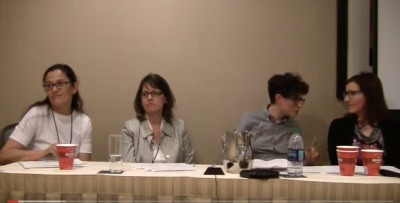
This roundtable was organized by Nicoletta Marini-Maio, Editor of gender/sexuality/italy, and Michela Baldo at the American Association for Italian Studies annual convention in Baton Rouge (AAIS) in April 2016. The presenters covered such topics as language inclusivity, misogynistic and asymmetrical uses of language, heteronormativity and homophobia in language, gender asymmetry in historical linguistics, grammatical norms, and trasnlingual practices. A lively discussion among the roundtable presenters and audience followed.

Read more Download pdf