category: Invited Perspectives

8.Where Myself Ends and Yourself Begins

by Veronica Mognato and Ana Treviño

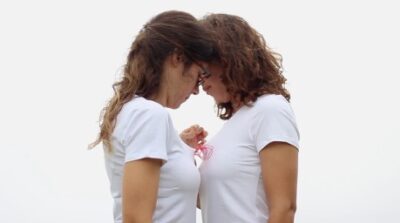
This article is about the shared experience of two visual artists that chose to collaborate on multiple projects. Their individual stories crossed in Austin, Texas, a city that has been hosting them for a few years, and were connected thanks to their similar way of seeing and living certain social mechanisms. Their first project embraces the concept of proxemics and how different cultures manage interpersonal spaces. The two artists come from different geographic zones and together,

Read more Download pdf
no post image

9.Collective Writing Projects as Sustainable Ecologies of Collaboration

by Paolo Saporito

What does it mean to engage in collaborative practices? How do these practices ensure the sustainable management of diversity we need in order to counter contemporary forms of discrimination? This paper reflects on these issues and proposes answers to these questions by analysing two case studies: the Italian writing collectives Wu Ming and Joana Karda. The two groups enact collaborative practices that deconstruct conceptual dualisms (i.e. subject/object; self/other) and question hyper-individualised conceptions of subjectivity characterising contemporary neoliberal society.

Read more Download pdf

10.Individual and Collaborative Film Studies in Italy: Legal Constraints and the Gender Balance

by Damiano Garofalo and Dom Holdaway

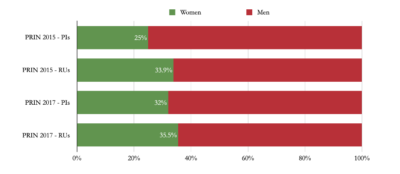
In this article, we offer a handful of reflections about collaborative scholarship in Italy, referring in particular to the principal public funding scheme for research—the so-called “Progetti di rilevante interesse nazionale” (PRIN), organized and financed by the Ministry for Education, Universities and Research (MIUR). We draw, moreover, on our experience working on “The International Circulation of Italian Cinema,” a project on which we both collaborated as postdoctoral researchers at different times between 2017 and 2020.

Read more Download pdf
no post image

11.My Way to Philosophy

by Francesca Rigotti

Here, an account is provided, in autobiographical form, of the path of the author toward philosophy, as a calling, from the choice of university faculty to the first experiences as researcher, until her encounter with the theme of metaphor, true love at first sight, and beyond. You can read about the birth of her form of thought: “impertinent thought,” including the contamination of genders and the philosophy of daily life,

Read more Download pdf
no post image

Gender/sexuality/Italy 6 (2019) – Table of Contents

Table of Contents – Gender/sexuality/Italy, 6 (2019)

Nicoletta Marini-Maio, Journal Editor

Julia Heim, Charlotte Ross, and SA Smythe, Themed Section Guest Editors

Paola Bonifazio, Invited Perspectives Editor

Ellen Nerenberg, Open Contributions and Continuing Discussions Editor

Erica Moretti and Colleen Ryan, Reviews Editors

Victor Xavier Zarour Zarzar, Managing EditorGuido Capaccioli, Lisa Dolasinski, Samantha Gillen, Giorgio Losi, Katherine Travers, Assistant Editors

Journal Editorial.
NICOLETTA MARINI-MAIO, Dickinson College
PAOLA BONIFAZIO,

Read more Download pdf
no post image

Journal Editorial

by Nicoletta Marini-Maio, Paola Bonifazio, Ellen Nerenberg

The editorial includes the Editors’ introductions to their respective areas: Nicoletta Marini-Maio announces the topic and guest editors of the Themed Section; Paola Bonifazio presents the Invited Perspectives; and Ellen Nerenberg details the contents of the Open Contributions and the section Continuing Discussions, which hosts informed voices on themes developed in previous issues of g/s/i.

Read more Download pdf

7.Metastasio per trans

by Egon Botteghi

The “musicians” (euphemism used for the castrated singers) appear in Italy by the end of the sixteenth century, following a Papal Decree that forbade women to sing in church and consequently in theatres. Throughout the following three centuries, musicians ruled the European music scene, becoming one of the most important exported “goods” from Italy. Created by other men for artistic as well as political and devotional purposes, these men are described in the literature of the time as “chimeric beings,” halfway between a man and a woman,

Read more Download pdf

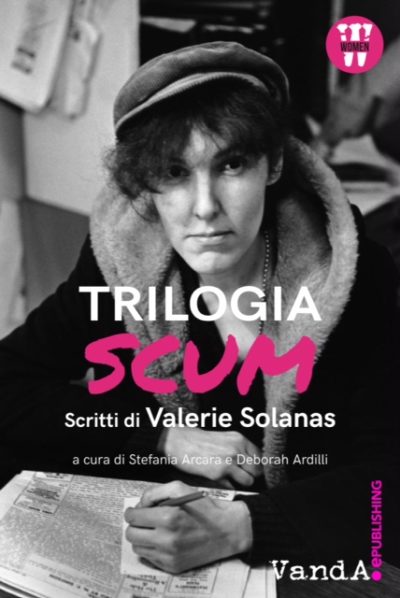
8.Valerie Solanas’s Trilogia SCUM: A feminist translation project of care. Interview/dialogue with Stefania Arcara and Deborah Ardilli.

by Stefania Arcara, Deborah Ardilli, Michela Baldo

This interview focuses on the recent publication of Trilogia SCUM (2017), the Italian translation and retranslation of the complete works by radical lesbian feminist Valerie Solanas (editors Stefania Arcara and Deborah Ardilli). Solanas’s publication is discussed as a feminist translation project of care: through the use of abundant paratextual material, and through the restoration of Solanas’s uncensored SCUM Manifesto (1967), Arcara and Ardilli have joined efforts in reconstituting the legitimacy of Solanas as a feminist writer,

Read more Download pdf

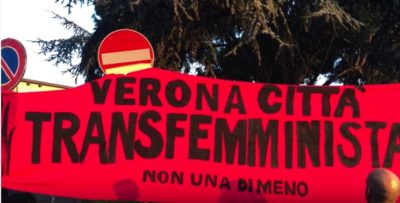
9.Feminism Makes History in Verona: The Response to the World Congress of Families

by Alessandra Montalbano

The last weekend of March 2019, Verona was at the center of media attention for having hosted the XIII World Congress of Families (WCF). However, the feminist response to this ultra-conservative and religious event became the true news. The transnational feminist movement Non Una Di Meno (NUDM) organized a three-day mobilization that included the biggest march in the history of Verona and had a strong impact on public opinion.

Read more Download pdf
no post image

10.Maternità, relazione, vulnerabilità: Una prospettiva filosofica

by Anna Argirò

This article focuses on motherhood as a point of arrival for the biological and social spheres, as well as the public and private, the physical and psychic. Feminist philosophies of our age converge and confront each other around this topic. The article proposes that we emancipate motherhood from its biological status by elevating it into a philosophical category which allows us to reflect on the complexity of the human condition and initiate a dialogue between the varying philosophical perspectives of contemporary feminism.

Read more Download pdf