

category: Themed Section

no post image

gender/sexuality/italy 8 (2021) – Table of Contents

gender/sexuality/italy, 8 (2021) 

Nicoletta Marini-Maio, Journal Editor
Paola Bonifazio, Invited Perspectives Editor
Ellen Nerenberg, Open Contributions and Continuing Discussions Editor
Erica Moretti and Colleen Ryan, Reviews Editors
Victor Xavier Zarour Zarzar and Lisa Dolasinski, Managing Editors
Arianna Avalle, Beatrice Basile, Leonardo Cabrini, Magda Collazo, Jacob DeCarli, Samantha Gillen, Katherine Travers, Assistant Editors

Table of Contents

Journal Editorial
NICOLETTA MARINI-MAIO, Dickinson College, 
Read more Download pdf
no post image

Intersectionality in Italian histories, cultural products, and social practices

Journal Editorial by Nicoletta Marini-Maio, Paola Bonifazio, Ellen Nerenberg

The editorial includes the Editors’ introductions to their respective areas: Nicoletta Marini-Maio announces the topic and guest editors of the Themed Section: “Intersectionality in Italian histories, cultural products, and social practices.” Marini-Maio also highlights the section Collaborations, which hosts discussions and descriptions of current scholarly collaborations. Paola Bonifazio presents the rationale of the Invited Perspectives.

Read more Download pdf
no post image

2.Il paradigma dell’intersezionalità: Migrazione e disparità lavorativa in Italia

by Claudia Santoni

The essay traces the emergence of the framework of intersectionality in the evolution of feminist theory in a contemporary key. The intersectionality perspective allows us to identify the oppression of women in its various configurations, showing female subjectivities that differ in terms of ethnicity, culture, religion, race. All forms of inequality, therefore, have an intersectional character being the product of the interaction of different factors which then affect the opportunities and choices of individuals.

Read more Download pdf
no post image

3.Piazza dei Cinquecento in Igiaba Scego and Porpora Marcasciano

by Alice Parrinello

Piazza dei Cinquecento, in Rome, is dedicated to five hundred Italian colonising soldiers who died in nineteenth-century Eritrea. Contributing to the national narrative, the piazza constructs them as mere heroic victims. Simultaneously, the piazza is central in two novels that challenge normative discourses on Italianness: L’aurora delle trans cattive (2018) by Porpora Marcasciano and La linea del colore (2020) by Igiaba Scego.

Read more Download pdf
no post image

4.Linguistica intersezionale in Italia

by Rosalba Nodari

What does it mean to use the framework of intersectionality in linguistic analysis? Is it possible to apply it to Italian linguistics in a fruitful manner? To answer these questions, it is necessary to understand how and when the terms “intersezionalità / intersezionale” entered the Italian lexicon. To elucidate the history of these terms, this article makes use of various corpora comprising written sources in Italian as well as online databases.

Read more Download pdf
no post image

gender/sexuality/italy 7 (2020) – Table of Contents

Gender/sexuality/Italy, 7 (2020) 

Nicoletta Marini-Maio, Journal Editor
Paola Bonifazio, Invited Perspectives Editor
Ellen Nerenberg, Open Contributions and Continuing Discussions Editor
Erica Moretti and Colleen Ryan, Reviews Editors
Victor Xavier Zarour Zarzar and Lisa Dolasinski, Managing Editors
Arianna Avalle, Beatrice Basile, Samantha Gillen, Giorgio Losi, Natura Sant Foster, Katherine Travers, Assistant Editors

Table of Contents

Journal Editorial.
NICOLETTA MARINI-MAIO, Dickinson College, 

Read more Download pdf
no post image

Journal Editorial

by Nicoletta Marini-Maio, Paola Bonifazio, Ellen Nerenberg

The editorial includes the Editors’ introductions to their respective areas: Nicoletta Marini-Maio announces the topic and guest editors of the Themed Section: “Beside, Besides, and B-sides: Collaborations as Feminist and Decolonizing Practices.” Paola Bonifazio presents the rationale of the Invited Perspectives. details the contents of the Open Contributions and the section Continuing Discussions, which hosts informed voices on themes developed in previous issues of g/s/i.

Read more Download pdf

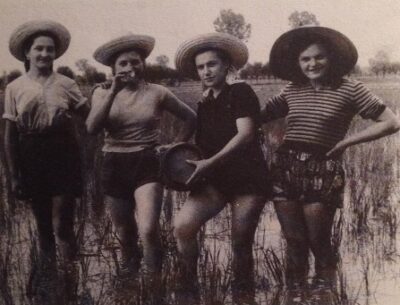
4.Riding the Stock Car to Sleep in the Stables: Migrant Agricultural Labor and Songs of Rebellion

by Diana Garvin

Under Mussolini’s dictatorship, both the physical abuses of a misogynist state and the political power of female friendship were written in the sensory details of agricultural workers’ everyday lives. This article uses archival and melodic evidence from the sensorial world of interwar Italy to explore four interlinked case studies, ultimately revealing what is at stake in women’s work songs. First, written testimonials and transcriptions from oral interviews show that, for many mondine,

Read more Download pdf
no post image

5.Addressing Each Other’s Eyes Directly: From Adriana Cavarero’s “Relating Narratives” to Elena Ferrante’s Intersectional Ethics of Narrative Relations

by Loredana Di Martino

Narratives that provide honest portrayals of women’s relationships appear to be very popular at the moment. This may seem as nothing new since feminist authors have recast female friendship as a potential site of subversion at least since the seventies. However, as critics have highlighted, it is particularly since the eighties and nineties that representations of ambivalent female relations have become more prominent, mostly as a result of the influence of intersectional and decolonial theories such as those pioneered,

Read more Download pdf
no post image

6.Rural Italy in Feminist Writing: Dialogism, Polyphony, and Heteroglossia in Armanda Guiducci’s La donna non è gente

by Viviana Pezzullo

Armanda Guiducci’s La donna non è gente (1977) is a volume collecting related autobiographical narratives in which collaboration is the result of the dialogic, polyphonic, and heteroglot relationship between Guiducci and the women narrators she interviews. Guiducci’s work proves how the notion of singular authorship and language of noi is inadequate to capture the diversity of women’s struggles across Italy. In La donna non è gente, the narrators–women from rural areas of north and of south Italy–embody through the alternance of Standard Italian and regional and local dialects the dialectics between urban and rural spaces.

Read more Download pdf