category: Open Contributions

12.“Per me il documentario è relazione”: The Eloquence of Found Footage and Garment Workers’ Rights in Costanza Quatriglio’s Triangle

by Valeria Castelli

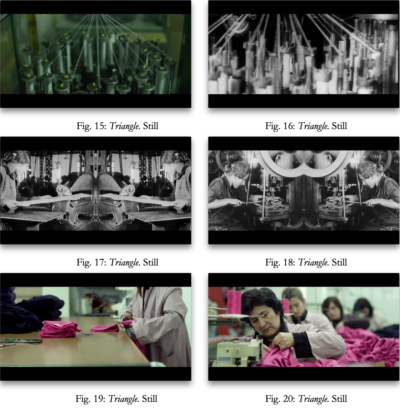
This article examines Costanza Quatriglio’s use of found footage in Triangle (2014). This documentary film deals with the collapse of a building in Barletta in Apulia in 2011, in which four female textile workers and the factory owner’s daughter were killed. These deaths in the workplace are correlated with the notorious case of the victims of the fire at the Triangle Waist Company factory in New York in 1911. Quatriglio creatively uses found footage to persuade viewers of the similarities between the two accidents at work,


Read more Download pdf
no post image

Gender/sexuality/Italy 6 (2019) – Table of Contents

Table of Contents – Gender/sexuality/Italy, 6 (2019)

Nicoletta Marini-Maio, Journal Editor

Julia Heim, Charlotte Ross, and SA Smythe, Themed Section Guest Editors

Paola Bonifazio, Invited Perspectives Editor

Ellen Nerenberg, Open Contributions and Continuing Discussions Editor

Erica Moretti and Colleen Ryan, Reviews Editors

Victor Xavier Zarour Zarzar, Managing EditorGuido Capaccioli, Lisa Dolasinski, Samantha Gillen, Giorgio Losi, Katherine Travers, Assistant Editors

Journal Editorial.
NICOLETTA MARINI-MAIO, Dickinson College
PAOLA BONIFAZIO,

Read more Download pdf
no post image

Journal Editorial

by Nicoletta Marini-Maio, Paola Bonifazio, Ellen Nerenberg

The editorial includes the Editors’ introductions to their respective areas: Nicoletta Marini-Maio announces the topic and guest editors of the Themed Section; Paola Bonifazio presents the Invited Perspectives; and Ellen Nerenberg details the contents of the Open Contributions and the section Continuing Discussions, which hosts informed voices on themes developed in previous issues of g/s/i.

Read more Download pdf

13. Italian Office Workers from Comedy Italian Style to Ugo Fantozzi: A Gendered Perspective

Represented as a male-dominated space, the office is a privileged site of production of masculine identities in comedy Italian style. The high-ranking male clerical worker is therein depicted as a paradigm of successful masculinity in the Italian economy’s boom years. A trademark of successful masculinity, office design and its filmic representations has evolved throughout the decades, to reflect status and rank, and also a muted aesthetic taste. Comedy Italian style was not the first to represent office interior space as much as to appropriate it (alongside the restaurant,

Read more Download pdf
no post image

14. Anorexic symptoms in Clara Sereni’s Casalinghitudine

Structured like a cookbook, the autobiographical novel Casalinghitudine (1987) by Clara Sereni uses food preparation, consumption, and preservation as a narrative mechanism to reflect on the protagonist’s journey towards self-awareness and gender and ethnic identity formation. The highly subjective nature of this text is immediately obvious in several ways, such as the assertive tone of the recipes through the predominance of the agent ‘I’ and the overall organization of the book that unusually starts with a section on baby food. 

Read more Download pdf
no post image

15. Cosa scrivevano le donne di fine Ottocento? Il contributo italiano alla Woman’s Building Library della World Fair di Chicago (1893)

Questo saggio presenta la ricostruzione della lista di libri inviati dall’Italia alla Woman’s Building Library della Fiera Mondiale di Chicago del 1893. I 222 testi, radunati nel corso di pochi mesi da Alice Howard Cady e Fanny Zampini Salazar, diventarono parte della prima biblioteca pubblica al mondo interamente dedicata alla scrittura al femminile. In quanto tali, costituiscono una testimonianza eccezionale della partecipazione delle donne italiane alla letteratura ed alle scienze mondiali. Discutendo le tipologie e i generi dei testi,

Read more Download pdf

Girl Cultures in Italy from Early Modern to Late Capitalism. Journal Editorial

by Paola Bonifazio, Nicoletta Marini-Maio, and Ellen Nerenberg

The editorial includes the Editors’ introductions to their respective areas: Paola Bonifazio and Nicoletta Marini-Maio discuss the Themed Section and the Invited Perspectives; Ellen Nerenberg presents the Open Contributions and the new section, Continuing Discussions, which hosts informed voices on themes developed in previous issues of g/s/i.

DOI: https://doi.org/10.15781/cj1b-3j07

Read more Download pdf

10. The Importance of Being Ernesto: Queerness and Multidirectional Desire in Umberto Saba’s Unfinished Novel

by Paolo Frascà

This article explores Umberto Saba’s (1983-1957) only and unfinished novel, Ernesto (1975), from the perspective of sexuality and Queer studies, while also paying attention to the novel’s language and its autobiographical underpinnings. By examining aspects of the work that render it an important testimony of queer desire, this essay aims to shine a light on Ernesto as an important Italian literary text and on the text’s ability to reveal significant and timeless aspects of the human condition,

Read more Download pdf

11. La Gaia Piazza. Le orme del movimento gay nella Parma negli anni Settanta

by Antonella Grassi

This article aims to explore the gay movement of Parma in the 1970s, to show its implicit, ante litteram consonance with the queer discourse. The ability to reinvent itself was the peculiar feature of the Parma group, always aware of the constant evolution of artistic forms: this made it a unique case in Italy, as well as a privileged point of view for studying the evolution of the national gay movement.

Read more Download pdf