Editorial: Gender and Language: Contributions and Response to a 2016 AAIS Roundtable
by Paola Bonifazio
A brief summary of essays included in g/s/i no. 3 Invited Perspectives.
DOI: https://doi.org/10.15781/tx7d-5×56

gender/sexuality/italy is an online annual, peer-reviewed journal that publishes research on gendered identities and the ways they intersect with and produce Italian politics, culture, and society.
by Paola Bonifazio
A brief summary of essays included in g/s/i no. 3 Invited Perspectives.
DOI: https://doi.org/10.15781/tx7d-5×56
by Michela Baldo
Michela Baldo introduces the theme of the AAIS 2016 roundtable, that is those discourses of gender and sexuality circulating in Italy oriented in a homophobic, transphobic, sexist and misogynist way, but also the ways in which language can become a tool to fight discrimination. The author subsequently introduces queer linguistics, a branch of linguistics that aims to challenge essentialist, hegemonic and naturalized notions of gender and sexuality, and that can be useful in unmasking the work of heteronormativity in the formation of public discourses.
by Cinzia Russi
Cinzia Russi demonstrates how Darla “be promiscuous, of women” and darlo “engage in sodomy” first appear in the sixteenth century; in the late twentieth century, darlo acquires the meaning of “have sex, of men” (same as darla but without the connotation of “easiness”). While darla is well established in the average speaker’s lexicon, darlo (in both meanings) remains highly marginal.
by Michela Baldo, Serena Bassi, Juliet Guzzetta, Cinzia Russi
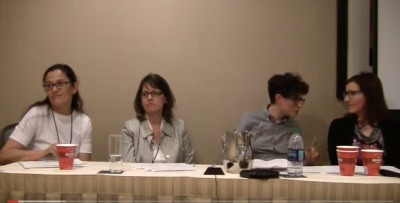
This roundtable was organized by Nicoletta Marini-Maio, Editor of gender/sexuality/italy, and Michela Baldo at the American Association for Italian Studies annual convention in Baton Rouge (AAIS) in April 2016. The presenters covered such topics as language inclusivity, misogynistic and asymmetrical uses of language, heteronormativity and homophobia in language, gender asymmetry in historical linguistics, grammatical norms, and trasnlingual practices. A lively discussion among the roundtable presenters and audience followed.
by Cecilia Robustelli and Nicoletta Marini-Maio
This interview provides a panorama of the institutional intiatives on the issue of gender and language in Italy since the creation of the Comitato nazionale di parità in 1983 and the publication of Alma Sabatini’s seminal study Il sessismo nella lingua italiana in 1987 to date. Robustelli argues that because of its ample scope including linguistic, cognitive, and cultural aspects, Sabatini’s work has not only raised the interest of feminist groups,
by Ellen Nerenberg
A brief summary of essays included in g/s/i no. 3 Open Perspectives
DOI: https://doi.org/10.15781/8aa3-jr63